
Reading is not natural
Reading in the brain


Try not reading what’s on the picture above. It’s hard, isn’t it? If you are a native English speaker without dyslexia or any similar conditions, it’s probably nigh on impossible. Reading feels automatic once you are proficient at it.
But it doesn’t start out that way.
Reading is not a ‘natural’ skill children develop unaided. It requires thousands of hours of practice and repetition to get to that level of automaticity. As I am trying to assemble a list of skills an ‘ideal’ school should equip a person with, I am struggling to whittle it down to something workable. It’s harder than it seems. Should I include basic life skills like being able to navigate around a city or is that purely in the parental domain? I’ll hazard a guess, though, that no matter whom you ask, they’d put reading on the list.
I don’t have to belabour the point that reading is pretty much the core skill you need to learn to function in the modern world. Well, and with that I move on to the not-at-all-controversial topic of how on Earth you actually teach children to read?
The answer to that is complicated and surprisingly political (look up the controversy around the whole word method if you simply must get more political entertainment in your life). I am a big fan of trying to understand things from first principles, and given my neuroscience background, I figured that the first step towards getting to an answer would be to delve into how reading works in the brain.
Enter the excellent Reading in the Brain by Stanislas Dehaene: a scholarly yet still easy-to-read book on the neuroscience of reading and the resulting rabbit hole of numerous peer-reviewed articles.
Ok, ok, so how does reading work in the brain?
It all starts with the eyes
Reading, or in the catchy nomenclature of neuroscience research, ‘written word processing’, starts with the eyes.
When you see a letter, the light reflected off it travels to the retina, a thin light-sensitive layer at the back of the eye, which turns light into electrical signals and passes the information further in the brain. Those signals encode tiny fragments about the letters (shape, size, orientation etc.), which are then progressively reconstructed in the visual system and eventually recognised.
But it’s only a small part of the retina, at its center, called the fovea, where there’s fine enough resolution to allow for recognition of small letters. As we read, our gaze must, therefore, constantly move around the page.
Each time the eyes stop, we can process one or two words. Then we move our eyes again and get the next couple of words and so on and on. If you were to film the eyes of someone reading, their eyes jerkily shift in swift succession from side to side. Each of these moves is called a saccade and we make about 4-5 of these per second.
There is a special place in the brain for reading
Once the information from the page travels from the retina it heads to the visual cortices in both hemispheres, where initial processing takes place.
For complex objects/images like the written word, there are further processing regions. So, from the visual cortices, the information travels to a specialised area of the brain responsible for reading. Dehaene calls it the ‘brain’s letterbox’. Other cognitive scientists usually refer to it as the visual word form area aka the ‘VWFA’.
And now comes the cool thing: this ‘letterbox’ is approximately in the same area in all people who can read across all languages: in the left occipito-temporal region of the brain.
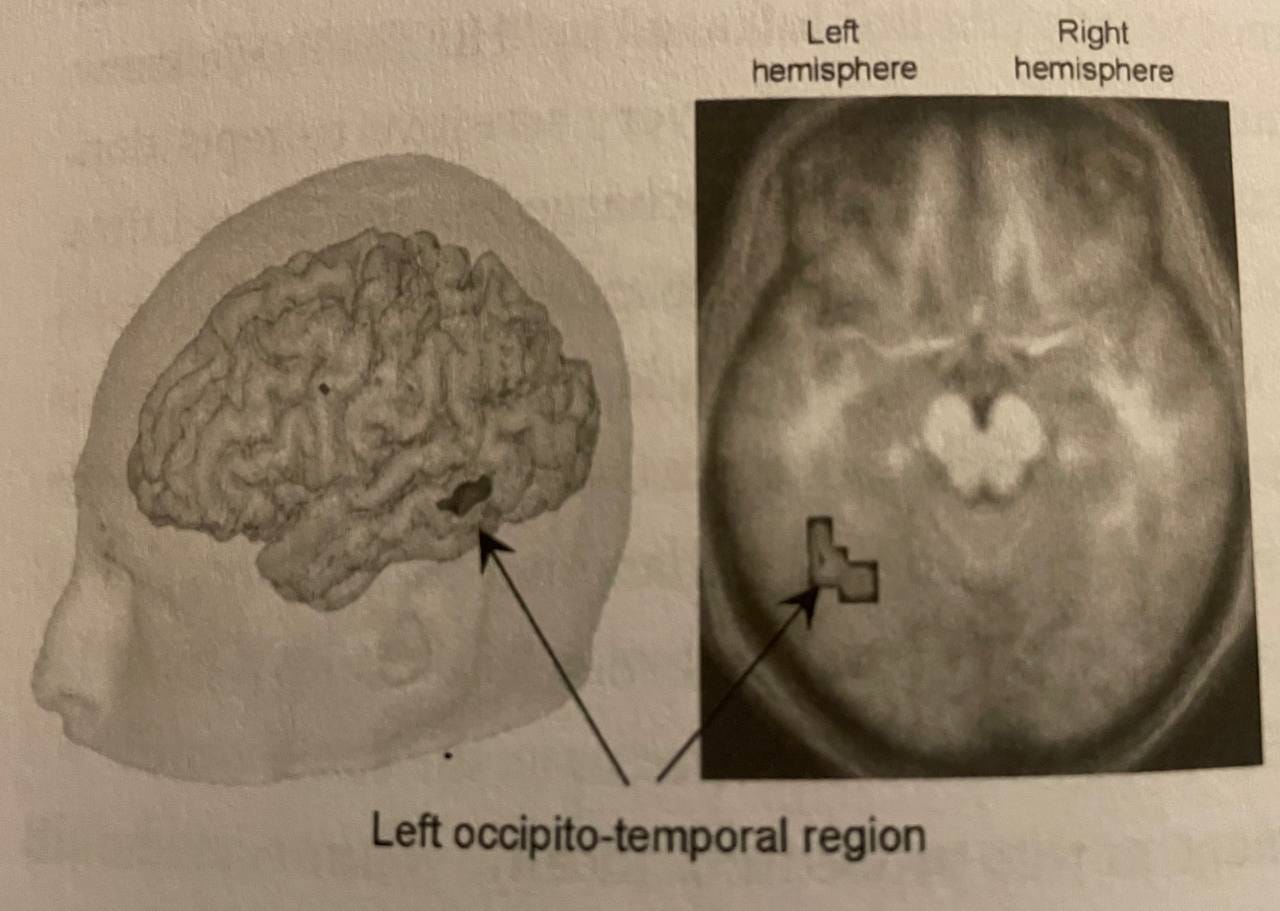
This may not sound remarkable. After all, there are specialised areas for movement or breathing in the brain, but it is mind-blowing if you think about it for a second.
Reading has only existed for perhaps ~5,400 years, a blink of an eye in evolutionary time, yet there is this part of the brain dedicated to reading that’s broadly consistent across people who read English, Czech, Arabic or Chinese.
Dehaene has a theory to explain this consistency that he calls the ‘recycling hypothesis’. He theorises that the location of the letterbox area is so consistent across people because of the specific predispositions of the neurons in the left occipito-temporal region. In any case, it’s pretty mind-blowing.
The two key routes for reading - phonological and lexical
Once the information arrives into the letterbox, we are really in the thick of it. The letterbox is the place where the brain specialises in recognising word-like forms and letters. It identifies the letters and passes the information onto other parts of the brain to, at last, make sense of the words.
There are two major pathways through which reading is processed to get to meaning: the phonological and lexical routes.
The phonological route
The phonological route converts letters into speech sounds. Information along this route travels from the letterbox region to regions largely in the left hemisphere that have to do with sound and inner speech (e.g. Broca’s area).
The best way to demonstrate is to read the below excerpt from a little-known short story by Edgar Allan Poe, ‘The Angel of the Odd’.
“Mein Gott !” said the Angel of the Odd, apparently much softened at my distress; “mein Gott, te man is eder ferry dronk or ferry zorry. You mos not trink it so strong -- you mos put te water in te wine. Here, trink dis, like a goot veller, und don’t gry now -- don’t !”
Reading the excerpt brings me back to first grade, sounding out the words, and through sound suddenly, almost as if by magic, discovering their meaning.
That’s the phonological route at work, where meaning is arrived at through sound. Whenever you encounter an unknown word, that is how you read it at first.
Any teachers/homeschooling parents out there?
Anyone reading this with experience of teaching children read (in any language whatsoever), I would be very keen to hear your thoughts and more about your experiences. DM me or drop a comment below.
The lexical route
The lexical route gives access to a mental dictionary of word meanings. It only works for words a person has encountered before and which exist in their mental dictionary. All the words you read in this piece are primarily using the lexical route. Your brain sees the letters of a word ‘R E A D’ and matches it with the word ‘read’.
The way and speed with which the brain manages to recognise a word from among thousands it knows is remarkable. Dehaene describes it using a metaphor first coined by Oliver Selfridge in 1959 termed the ‘pandemonium’, where the human reading system is likened to an immense semicircle where tens of thousands of daemons compete with one another. Each daemon responds to only one word. When his word is presented he yells to defend it. So when you are reading, a string of letters is shown, and all the daemons who think the string could make up their word yell.
When, say, ‘scream’ appears, the daemon for ‘scream’ yells, but so does his neighbour for ‘cream’. The neighbour shortly yields, since the ‘scream’ daemon has a better case for his word than the ‘cream’ daemon. In essence, this demonstrates that the brain has massive parallel processing capability; all the daemons are examining the word at the same time.
We know that the information travels from the letterbox area to a distributed language network, especially in the left temporal lobe, but the details from a neuroscience perspective still escape us.
And that’s it. A very simplified journey of the written word through the brain to arrive at meaning.
What does this mean for teaching children to read?
Now, what does it all mean for teaching children to read?
Above all, knowing more about how reading works in the brain gave me some insight into just how complicated it is to learn to read. The curse of knowledge is hard to overcome. I cannot help but read a word put in front of me, so it’s hard to understand why my little cousin struggles to sound out ‘apple’ for what feels like the millionth time.
The brains of young children exposed to words show next to no activity in the ‘letterbox’ region. It takes many years for this specialised part of the brain to establish. The wiring doesn’t mature until well into one’s teenage years, and that is when a child reads frequently, not exactly the norm nowadays in our purportedly post-literate society.
The process of reading I described above is what happens in the brain of a skilled (usually adult) reader. Children initially see words more as images or logos. This is where kids might recognise their name. It’s not that they are reading it as such. They recognise the shape of the word and learn to associate it with the meaning of their name. Only later do children learn to associate individual sounds with letters, and slowly they grow capable of sounding out words and arriving at meaning through the phonological route. Much later still do they learn to readily access word meaning via the lexical route.
All these skills must be explicitly taught and practised.
Dehaene quotes studies of illiterate people who struggle to identify the words ‘tower’ and ‘table’ as beginning with the same sound. Being able to associate sounds with letters is a cornerstone of reading. A cornerstone, humans do not learn without being taught explicitly. Learning to read is a long process that requires substantial rewiring of the brain.
I hope knowing this will help me muster more patience when teaching reading and respect for the amazing skill that it is.
Trying to navigate the vast literature and the very strong opinions out there on how to teach children to read takes a minute. Having some understanding of how reading works in the brain is pretty helpful in judging which techniques are promising. Now, I know, that nothing beats classroom practice, but I am at least pretty sure that the technique we will use will be very phonics heavy.
If you are interested to learn more about why I want to start a school, see below
You might also enjoy these:
I homeschool and am just starting to teach my 3rd child how to read. This was my experience with the first 2: We started maybe age 3. I tell them the sounds of the letters rather than the names of the letters. We play I spy, saying, find me the thing (out of maybe 3 items in front of them) that begins with… (make the sound). When I read simple books to them or we look at a word, I will show them how each letter sounds to make the word. And I kind of force it, even when the word is odd or not totally phonetic. The kids went through stages where they’d first understand that words are made of symbols that represent sounds, then remember the sounds of the letters, then kind of painstakingly sound letters out to read the word (for quite a while), then very suddenly just start reading all words, even large ones, fluently like adults. My first son got to this stage very early, right before turning 4. My second was maybe 5. I’m curious if the 3rd is the same. I think they’re all predisposed to be good readers, so I’m not sure it would be the same with everyone. It was fascinating to watch!
Another comment, related to your desire to start a school. If you have not seen it, make sure to find and watch a copy of the movie "A Touch of Greatness." If every teacher brought the level of passion and innovative ideas into teaching that is the subject of this movie, we would have a very different world.